
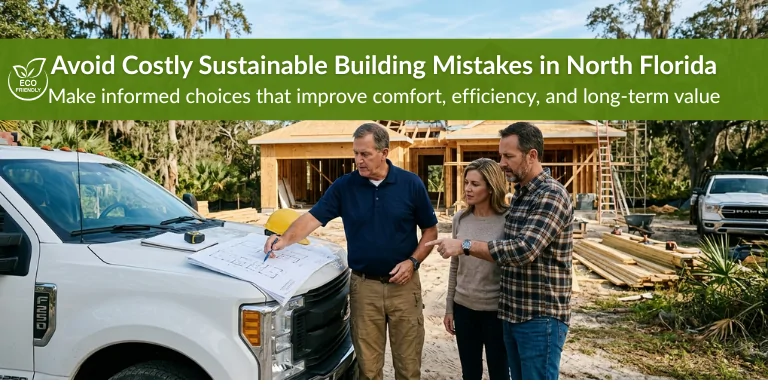
Building green in North Florida comes with a specific set of problems that most sustainability advice ignores. If you’re planning a custom home here, the heat lingering into October, the humidity that never really breaks, and the single summer storm that pushes more water at your foundation than the drainage was built to handle all shape decisions you’ll make long before move-in. Many green choices that look smart on paper quietly fail against those conditions, and by the time the problem shows up, it’s expensive to fix. Over years of building custom homes around Lake City, we’ve watched most of those regrets trace back to a handful of decisions made too early or too casually, which is exactly where a little foresight saves the most.
Don’t Prioritize Solar Before Improving Your Home’s Envelope
Solar tends to get budgeted first because it’s the visible proof that a home takes energy seriously. But putting a large array on a house with a mediocre building envelope is one of the most common mistakes we see.
If your insulation, air sealing, and windows underperform, you’re generating power just to lose it through the walls and roof. Across our long cooling season, that adds up fast. A tighter envelope with solid attic insulation and properly specified windows almost always returns more than extra panels on a leaky house.
The smarter sequence is simple: get the envelope right first, then size solar to a home that’s already efficient. You’ll usually need fewer panels to hit the same result, so if your budget forces a choice, put it into insulation and air sealing before the array.
Choose Sustainable Materials That Can Handle North Florida’s Climate
A material’s eco-friendly label tells you how it was made, but not always how it will behave in North Florida heat and moisture. Some sustainable products hold up beautifully here. Others swell, warp, or grow mold within a few seasons of meeting our humidity and wind-driven rain.
We weigh durability and long-term performance as heavily as any green credential. A material that needs replacing in eight years is rarely the sustainable choice, whatever the packaging claims. When you compare options, ask the two questions the brochure tends to skip:
- How does it hold up in sustained heat and high humidity?
- What does maintenance actually look like over 15 to 20 years?
Durable building materials that shrug off moisture and storms will outlast trendier products that were never engineered for a climate like ours.
Don’t Overlook Moisture Management in a Sustainable Home
If we could get homeowners to take one thing seriously before building, it would be this. In our region, moisture destroys homes slowly and from the inside. You can install every efficient feature on the market, but without real moisture control, none of it holds up.
Green builds sometimes make the problem worse. Tightening a home for efficiency without a matched ventilation strategy traps humidity indoors, which invites mold, degrades air quality, and ruins finishes. Efficiency and moisture control have to be engineered together. Proper drainage, vapor control, flashing details, and a ventilation plan sized to your HVAC aren’t glamorous, but they protect everything else you paid for.
Plan Energy-Efficient Design Decisions Early
The most valuable efficiency choices often cost nothing during planning and become expensive or impossible afterward. Orientation is the clearest case. Which way the home faces, where the largest windows land, and how overhangs shade the summer sun shape your cooling costs for the life of the house. A wall of west-facing glass with no shading, for instance, can turn a room into a heat trap every afternoon, while a modest roof overhang on the same wall keeps it comfortable. Revisit those after framing and you’re looking at a major expense.
Good efficient home design settles these early. During custom home planning, we map sun paths, prevailing breezes, and how you’ll actually use each space so the home works with our climate instead of against it.
Build for Future Sustainable Upgrades
You don’t need to install everything on day one, but you should decide what you might want later. Designing a home solar-ready, even if panels arrive years down the road, spares you from opening finished walls and roofing to add conduit, panel capacity, or structural support after the fact.
The same logic covers EV charging, battery storage, and HVAC zoning. During construction, running a dedicated circuit to the garage or leaving space in the panel is a small line item because the walls are already open and the electrician is already on site. Once everything is finished, the same work means cutting into drywall, patching, and repainting, which is where the real cost hides. Roughing in early is cheap. Retrofitting is not.
Not Every Sustainable Upgrade Delivers the Same Value
Sustainable features don’t all deliver the same value, and treating them as equal sends money to the wrong places. In North Florida, dollars aimed at insulation, air sealing, HVAC efficiency, and moisture control pay back dependably because our cooling season is long and punishing. Other upgrades are more about preference than measurable savings.
As a rough guide, the upgrades that reliably lower bills here are insulation, air sealing, HVAC efficiency, and moisture control, while things like premium finishes, certain smart-home add-ons, and some specialty green materials lean more lifestyle than savings. Choosing features you simply want is fine. The mistake is assuming they all perform equally, or funding visible extras while skipping the fundamentals that actually lower your bills.
A Few Smaller Mistakes Worth Naming
- Water-hungry landscaping: Lawns that need constant irrigation fight our climate. Native and drought-tolerant plantings look sharp and cost far less to keep alive.
- Assuming bigger is better: More square footage isn’t automatically a better home. A right-sized layout cools easier, maintains cheaper, and often lives more comfortably than rooms you rarely enter.
- Undersizing or oversizing the HVAC: An oversized system short-cycles and struggles to pull humidity out of the air, while an undersized one runs constantly. Right-sizing to the home matters more than chasing the highest efficiency rating.
- Ignoring the roof color and material: In our sun, a lighter or reflective roof can noticeably ease the cooling load, and it’s a choice that’s easy to get right upfront and costly to change later.
- Skipping shade you already have: Existing mature trees on the lot are free cooling. Clearing them for convenience during construction often means paying to replace that shade with mechanical cooling for years.
Building It Right From the Start
The homeowners who dodge these mistakes tend to share one habit: they made the big decisions early, alongside a builder who understands how homes behave in North Florida specifically.
Since 2004, we’ve built over 200 custom homes across the region, and that experience lives in exactly these details, the ones that never make the spec sheet but decide how a home performs for years. Our 4.7-star Google rating comes from homeowners who valued straight guidance before the money was committed.
If you’re planning a custom home in Lake City or anywhere in North Florida, the moment to talk is during planning, while every option is still open and every dollar can be pointed where it counts. Early conversations are where we catch the small decisions that quietly shape comfort and cost for decades, and there’s no pressure in having one.
Whether you’re ready to break ground or still comparing ideas, we’re happy to talk through your plans, answer your questions, and help you make informed decisions before construction begins. Call us now at 386-755-9314 to get started.